TRANSPORTATION SOLUTIONS
Variable Message Sign
Specify one variable message sign around its location, approved message set, controller, data input, mounting and safe failure behavior.
Explore Transportation SolutionsOne sign, one location, a clearly controlled message
A single VMS is a site-level system: LED display, controller, content source, communications link, mounting and maintenance plan. It should show information that is approved for that road and useful at that specific approach.
Use this page to scope one sign and its commissioning. For synchronized messages, shared control and multiple locations, review the Variable Message Signs network page.
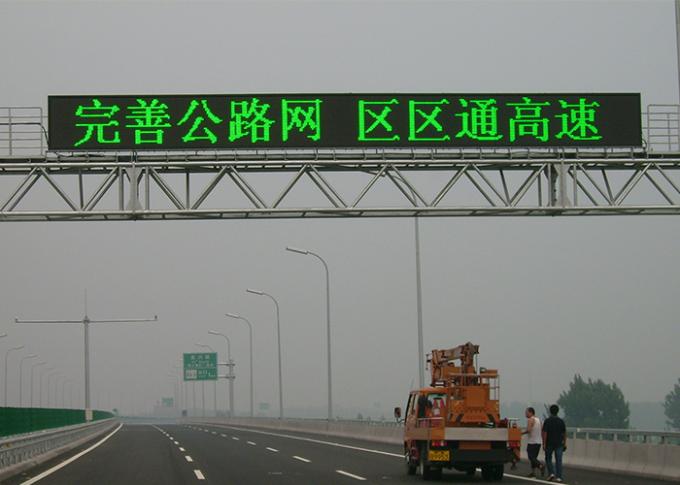
Specify the sign for its real viewing conditions
Use the actual approach distance, lane coverage and approved content to determine the display envelope and character scale. Confirm the controller, power and communications, mounting and service access with the site owner before procurement.
Define the job of this one sign
Start with the road condition this sign must communicate and the decision point it serves. A single-site VMS should have a clear owner, an approved message set and a defined content source, even when it is not part of a wider network.
Location and approach
Identify direction, lanes served, sight distance, mounting height and the point where a driver needs to act.
Message set and authority
Confirm permitted messages, symbols, priorities, language and who approves or clears each update.
Coordinate the display, support and site services
The sign face, enclosure, pole or gantry, foundations, power, communications and safe access form one installation. Review the complete site with the owner and responsible authority before fixing dimensions or cabinet orientation.
1. Measure the mounting envelope and confirm structural capacity.
2. Choose front or rear service based on access and maintenance conditions.
3. Coordinate power, data, grounding and protection from the environment.
Control the message from source to sign
Even one display needs a trusted path for commands and status. Define who can update content, how the controller confirms a command, when a message expires and what the sign shows if power, data or communications fail.
Approved message and expiry rules
Document allowed content, update authority, priority and when each message must clear.
Command and display confirmation
Test command acknowledgement and verify the actual displayed state at the sign.
Fault and maintenance modes
Define fallback behavior and how local service access is managed during an incident.
What to settle before specifying a single VMS
Road task
Describe the condition or approved information the sign will communicate and the action expected from approaching drivers.
Viewing geometry
Map approach direction, lanes, viewing distance, obstructions, mounting height and the location of the decision point.
Name the controller, command source, update path, status feedback and any data or trigger input used by the sign.
Confirm structure, power, communications, environmental protection, safe access, isolation and future service method.
Commission from the driver’s approach
Test with the approved message set at the installed location. Check sight lines, lane coverage, viewing angle, day and night brightness, startup, content updates, expiry, fault recovery and the maintenance handoff.
Driver-view acceptance
Review the sign from the intended approach and confirm that each message is recognizable and readable before the decision point.
System and handover checks
Exercise update and expiry, loss and restoration of power or network, controller alarms and delivery of as-built records and service instructions.
Prepare a complete single-sign project brief
Site and approvals
Provide a location plan, approach photos, asset owner, proposed mounting point, authority requirements and known constraints.
Display and control scope
Share message examples, display dimensions, control source, controller interface, power and network availability and the supply/integration boundary.
Acceptance and support
Agree driver-view checks, message and fault tests, training, as-built drawings, warranty response and maintenance ownership.
Explore related sign solutions
Variable Message Signs
For multi-location systems with coordinated messages, shared workflows and central monitoring.
Explore solutionLED Road Sign
For street-level sign applications with mixed road users and local site conditions.
Explore solutionLED Highway Sign
For overhead, high-speed road installations requiring gantry engineering and long-distance legibility.
Explore solutionFrequently asked questions
How is a single VMS sized?
Size depends on approved content, viewing distance, approach speed, lane coverage, mounting position and local requirements. Confirm dimensions and character scale through a site review and authority approval.
What happens if the controller or network fails?
Define the approved fallback or blank state, how faults are reported, who responds and how the sign returns to service. Test that behavior during commissioning.
Can a VMS be used without a central network?
Yes, if the site has a suitable approved command source and operating procedure. Specify how content is updated, permissions are controlled, status is checked and messages expire.
What should be tested at the site?
Check approved messages from the driver approach, day and night brightness, controller updates, expiry, fault reporting, loss and restoration of power or communications, and the service handover.
Define the location, message and control scope for one VMS
Share the site plan, road approach, intended messages, content source, mounting conditions and control interface. We can help review the LED display and single-site integration requirements.
Contact Highcolor