Shield the
LED face.
A resin-covered surface can help reduce direct damage to small LED packages during incidental contact and handling.

A clearer picture of protection.
Add a protective surface to an SMD LED display where everyday contact, cleaning and handling matter. Plan the right pixel pitch, finish and service method for your indoor installation.

GOB stands for Glue on Board. A transparent protective resin is applied over the face of an LED module, commonly after SMD LEDs have been mounted to the circuit board.
The coating helps shield exposed LEDs from routine contact and contaminants. It is a surface-protection choice; resolution, brightness and service access still come from the selected module, cabinet and control system.
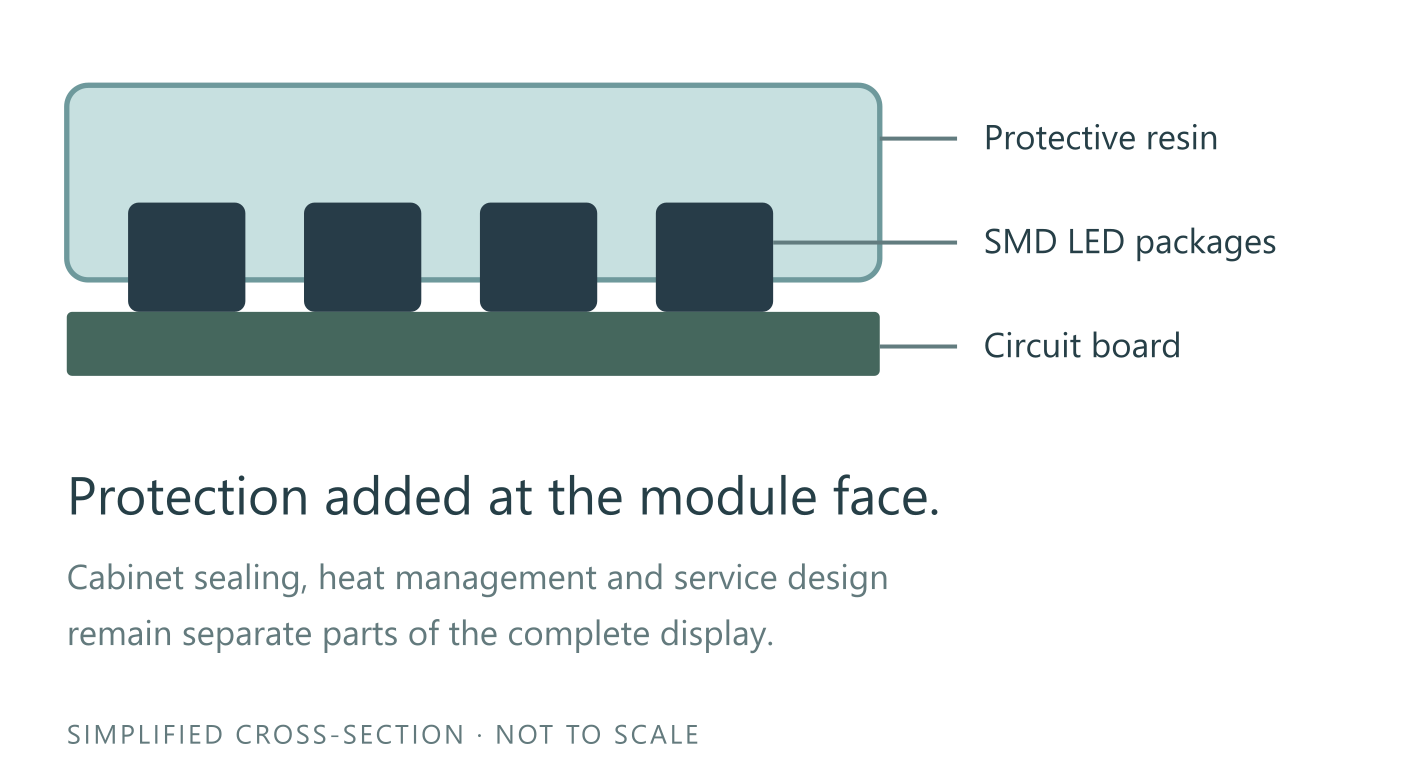
A resin-covered surface can help reduce direct damage to small LED packages during incidental contact and handling.
Surface encapsulation can simplify routine cleaning when paired with the approved cloth, cleaner and method.
Review reflections, black appearance, uniformity and detail on a sample under the intended ambient light.
Compare likely contact damage with the cost of replacement modules, specialist repairs and downtime.
Start with the exposure the display will actually face.
GOB is most useful when the LED surface is within reach or frequently handled. For a screen well out of reach, compare image quality, access and the complete ownership cost before adding protection.
Consider GOB for reachable displays in retail, lobbies and shared spaces. Match the surface finish, approved cleaning method and module replacement plan to the site.
Discuss this application ↗GOB adds protection to a finished module face. COB changes how LED chips are mounted. Compare actual products, not a universal ranking.
| Decision factor | Standard SMD | GOB-treated SMD | COB |
|---|---|---|---|
| Construction | Packaged LEDs mounted on a circuit board. | SMD module with a resin layer over the LED face. | LED chips bonded directly to a board and encapsulated. |
| Surface contact | LED packages may remain exposed. | Added surface layer helps shield the LED packages. | Encapsulated chip surface; protection depends on the product. |
| Image evaluation | LED package, calibration, pitch and driver configuration. | The same checks, plus coating finish and reflections. | Chip layout, encapsulation, calibration and driver configuration. |
| Service method | Module replacement or component repair, depending on design. | Module replacement may be available; resin rework can require specialist service. | Replacement and specialist repair depend on the module design. |
| When to compare | Surface contact is limited and standard handling protection is sufficient. | Reachable displays, repeated handling or cleaning make face protection useful. | Close-view detail and the exact model’s image performance are the priority. |
| Highcolor selection | Check the relevant indoor or rental product series. | This page lists P0.93 / P1.25 / P1.56 / P1.87 options; confirm the current configuration. | Highcolor’s currently stated COB offering is P0.6–P1.2. |
A GOB coating does not by itself establish a complete-cabinet IP rating, an IK impact rating or outdoor suitability. Use the test evidence for the exact product and installation.
Highcolor’s published GOB page lists these pitch options. Request the current model datasheet and cabinet layout for your project.
| Specification | Selection basis | Include in the proposal |
|---|---|---|
| LED module | GOB surface treatment on an SMD module. | Exact SKU, LED package, module dimensions and native pixel resolution. |
| Pixel pitch | P0.93 / P1.25 / P1.56 / P1.87 listed options. | Exact pitch and availability for the chosen cabinet. |
| Screen size & resolution | Available wall area, nearest viewer and content detail. | Cabinet rows/columns, finished dimensions and native pixel map. |
| Brightness & surface | Site lighting and expected reflections. | Calibrated brightness, viewing angle and sample finish. |
| Refresh & controls | Content, signal inputs and any camera use. | Driver, scan mode, receiving card, processor and test conditions. |
| Protection | Actual dust, moisture, contact and handling exposure. | Test scope, cabinet rating, surface limits and approved use. |
| Maintenance & power | Wall access, operating schedule and installation conditions. | Service direction, installed depth, max/average power conditions and spares. |
Review a sample before you finalize the wall.Compare unlit black appearance, reflections, low-brightness content, module boundaries and camera behavior where relevant.
Request model details ↗Choose by contact and maintenance needs. A room name alone does not determine whether GOB is the best fit.

For reachable brand displays near customers, stock movement and routine cleaning.

Keep public information and welcome content visible where staff and visitors pass close by.

Match text detail and viewing distance first. Add surface protection where the display is within reach.

Evaluate added handling protection together with the chosen cabinet’s transport and assembly design.
Module replacement and LED-level repair are different service tasks.
A coated module may be removable from the front in a suitable cabinet. Repairing an LED through the resin can be more specialized. Agree on the service route and compatible spares before the display goes into daily use.
Module map · calibration files · approved tools · cleaning instructions · replacement parts · support contact.
Get the manufacturer’s approved cloth, cleaner and pressure limits. Avoid abrasive tools, unapproved solvents and direct liquid application.
Check front or rear service, removal tools, module clearance, power isolation and the full installed depth.
Clarify which work is done on site, which parts return for specialist repair, and how coating or calibration is restored.
Confirm module compatibility, batch consistency, replacement lead time and acceptance checks after service.
Use a sample and a written acceptance checklist to compare what matters to your installation.
Inspect visible bubbles, surface flatness, finish and module-to-module appearance. Ask how coating defects are assessed.
Review grayscale, low-brightness content, color uniformity and reflections at the intended viewing positions.
Request test scope for protection, heat and expected operating hours on the exact module and cabinet.
Review the service procedure, compatible spares and matching after a module is replaced.

Highcolor manufactures LED display solutions in Shenzhen. Review the module, cabinet, controls and maintenance plan as one project, then confirm the configuration and acceptance evidence for the order.
For a comparable GOB project, ask for the coating type, pixel pitch, screen dimensions and service method.
Compare complete systems at the same size, resolution and service requirements. A coating label is not a project quotation.
Pitch, cabinet quantity and the native pixel map determine how much display hardware the project needs.
LED package, resin process, finish consistency, calibration and inspection requirements affect the configuration.
Mounting structure, power distribution, processing, signal inputs and service clearance belong in the scope.
Include packaging, freight, installation responsibilities, spares, repair arrangements and agreed support terms.
Clarify the construction, the limits and the service plan before comparing proposals.
Discuss your requirements ↗GOB means Glue on Board. It describes a protective resin layer applied over the face of an LED module, commonly one made with SMD LEDs. The coating helps protect the exposed surface; it does not change the module’s pixel pitch by itself.
No. GOB adds surface encapsulation to a module, while COB bonds LED chips directly to a board and encapsulates them. Compare the exact image performance, service process and configuration. Highcolor’s currently stated COB offering is P0.6–P1.2.
A surface coating alone does not establish complete-cabinet weather resistance. Ask for the tested IP rating, whether it applies to the module, front face or full enclosure, and the permitted installation conditions. Outdoor displays also need appropriate brightness, sealing, heat management and connections.
Yes, the finish and process can influence reflections, perceived contrast and uniformity. Review the exact sample in the intended lighting. For camera-facing use, test refresh, scan behavior, moiré and color together with the processor and camera settings.
A modular display may allow the complete module to be replaced. LED-level repair through the resin can need specialist removal and re-encapsulation. Confirm the manufacturer’s repair procedure, responsibilities, warranty terms and spare-module supply.
It can be considered as part of a purpose-designed product. Rental use also requires suitable rigging, locks, transport and service access. Floor use requires structural load ratings, slip resistance and impact evidence. A GOB coating does not make an ordinary display walkable.
No. Surface protection does not provide touch sensing. Interactive use needs a suitable touch system, controller and software, plus a display surface approved for the intended contact.
No. Clear resin lets light from the LEDs pass through the coating; it does not create see-through gaps in a conventional display. A see-through installation needs a purpose-designed transparent LED product.
Use the same screen dimensions, native resolution, brightness, cabinet construction and included equipment. Then compare coating specification, spares, replacement workflow, shipping, installation and support. A lower panel price may not mean a lower total service cost.
Send the application, dimensions, nearest viewing distance, lighting, expected contact or cleaning, service access, destination and timing. Mention camera, touch, rental or outdoor requirements so they can be assessed separately.