Six-sided LED display · geometry defined before production
Hexagon LED Screen
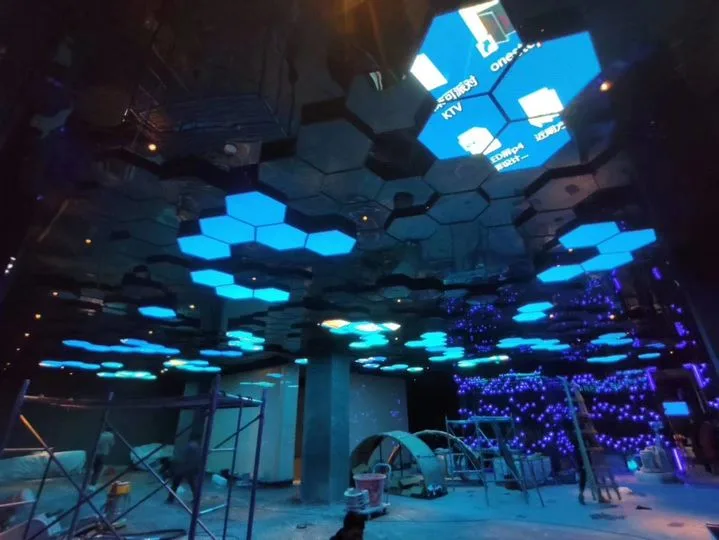
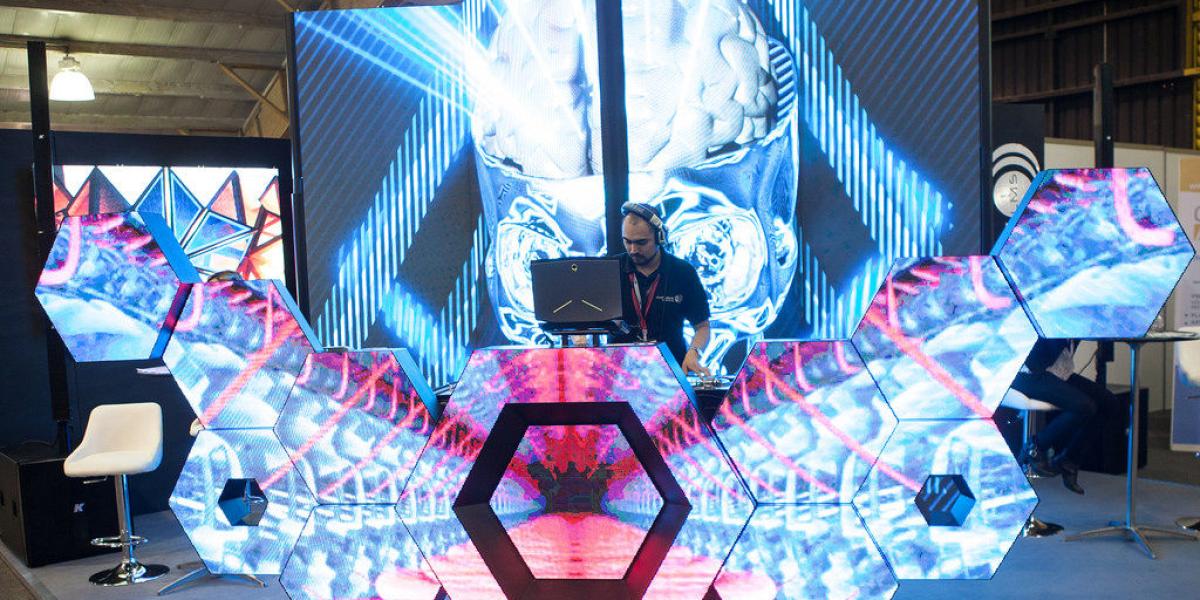
An LED hexagon screen combines six-sided display units into one panel or a coordinated honeycomb arrangement. The project depends on consistent edge orientation, cell gaps, shared boundaries and a pixel map that matches the chosen assembly—useful for feature walls, ceilings, event builds and custom retail displays.
Send Drawing & Dimensions →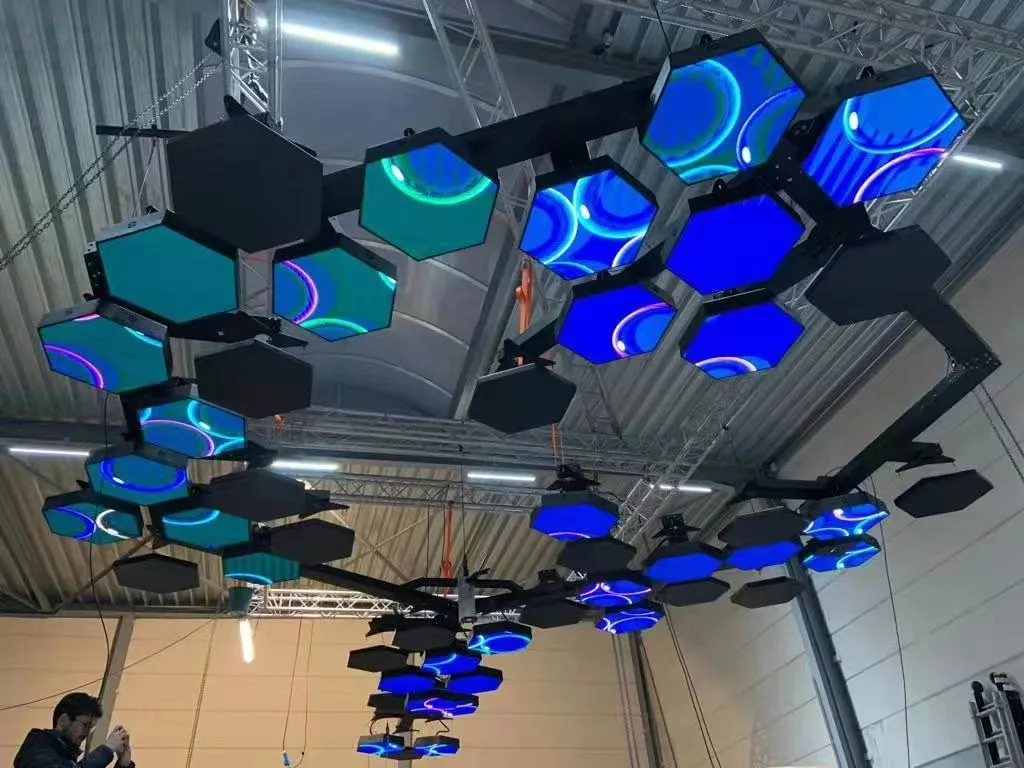
Definition
Define the Hexagon Geometry Before Choosing Modules
First decide whether the design is one six-sided display object or a honeycomb made from multiple hexagonal cells. These layouts need different drawings: a single unit centers on its overall dimensions, corner construction and mounting interface; a tiled arrangement also needs cell count, orientation, shared-edge gaps and alignment references. Confirm which edges are active display surfaces and which are trim or structure so engineering, content mapping and installation use the same definition.
If the outline uses multiple polygon shapes or unequal sides, compare it with an Irregular LED Display design.
Engineering
Engineering the Geometry of Hexagon LED Screen
Hexagon side length
This dimension establishes the primary geometric envelope and should be fixed on the approved drawing.
Flat-to-flat dimension
This controls how the active LED surface is divided, supported or viewed in the finished installation.
Point-to-point dimension
This value affects segmentation and should be coordinated with the intended viewer or host structure.
Corner angle
Record this explicitly so production does not infer the geometry from a concept rendering.
Cell gap
This parameter helps define repeatable assembly references, alignment and the real pixel canvas.
Number of hexagonal cells
Maintenance must remain possible after the decorative structure and LED surface are fully installed.
Specification
Drawing Inputs Required for Six-Sided Polygon
| Shape-specific engineering parameter | Value | Engineering use |
|---|---|---|
| Hexagon side length | Project-defined / confirm by drawing | Required to engineer the six-sided polygon geometry before production. |
| Flat-to-flat dimension | Project-defined / confirm by drawing | Required to engineer the six-sided polygon geometry before production. |
| Point-to-point dimension | Project-defined / confirm by drawing | Required to engineer the six-sided polygon geometry before production. |
| Corner angle | Project-defined / confirm by drawing | Required to engineer the six-sided polygon geometry before production. |
| Cell gap | Project-defined / confirm by drawing | Required to engineer the six-sided polygon geometry before production. |
| Number of hexagonal cells | Project-defined / confirm by drawing | Required to engineer the six-sided polygon geometry before production. |
These are RFQ/engineering fields, not claimed Highcolor performance specifications. Exact dimensions, pitch, brightness, protection and module construction must be confirmed for the selected product platform.
Content & mapping
Map the Pixel Canvas to Each Hexagonal Cell
Produce media from the approved active-pixel map rather than from the outside silhouette alone. Identify inactive borders, corner cuts, seams and any non-display faces; then document how each hexagonal cell is rotated and addressed in the controller layout. For synchronized honeycomb content, show how a graphic crosses shared edges. For independent cells, define the canvas and playback behavior of each unit separately.
Confirm the map with test patterns before creating final artwork. A conventional rectangular video can be a source format, but the final canvas must be transformed and positioned to match the real six-sided display geometry.
Installation decision
Coordinate Mounting, Cell Alignment and Service Access
Choose whether each hexagonal unit is independently mounted or connected through a shared frame. Set a common datum for the array, then specify cell orientation, joint spacing, edge support and installation sequence. Check that the support structure—not the LED modules—holds the intended angles and alignment. Plan access to power/data connections and replaceable sections before decorative finishes or neighboring units close off the service route.
For a design built from unequal polygon outlines, compare it with an Irregular LED Display system.
Cost drivers
What Changes the Cost of This Six-Sided Polygon Project?
Project cost depends on the number and size of the hexagonal cells, how their borders meet, the selected LED platform and the mounting structure. Corner and edge treatments, independent versus synchronized playback, service access and installation complexity can also change the scope. Ask for a drawing-based quote that separates active display area, structure, processing, installation and commissioning.
Cell Count
More cells can increase cabinet count, wiring, assembly and commissioning effort.
Edge Geometry
Corner and perimeter details affect cut pieces, finishing and the way adjacent units meet.
Shared-Border Alignment
Shared boundaries require consistent dimensions and alignment across the full honeycomb layout.
Independent Versus Synchronized Cells
Synchronized cells need coordinated mapping; independent cells need their own addressing and playback plan.
Drawing review
How to Review the Hexagon LED Screen Drawing Before Production
Review the drawing as a fabrication and installation document, not only as a concept rendering. Confirm the dimensions that define each hexagon, how the units meet, where the active pixels begin and end, and how the system will be supported, wired and serviced. Resolve conflicts between architectural references and site measurements before approving production.
Hexagon side length
Hexagon side length is a controlling envelope dimension for Hexagon LED Screen. Use the installed finished dimension and identify any trim, structural clearance or non-LED border separately so the active pixel area is not confused with the overall object size. Tolerance should be agreed where neighboring architecture or decorative finishes are already fixed.
Flat-to-flat dimension
Flat-to-flat dimension is a shape-specific project input for Hexagon LED Screen. Put the confirmed value on the controlled drawing and use the same value for structure, segmentation, installation references and commissioning. A site measurement and fabrication drawing should resolve any conflict before manufacturing.
Point-to-point dimension
Point-to-point dimension is a shape-specific project input for Hexagon LED Screen. Put the confirmed value on the controlled drawing and use the same value for structure, segmentation, installation references and commissioning. This is one of the dimensions that should appear in the RFQ rather than being left to supplier interpretation.
Corner angle
Corner angle fixes the relationship between adjacent surfaces. Record the design angle on the fabrication drawing so corner hardware, seam alignment and pixel mapping are based on the same datum. Changing it late can affect several downstream parts, so revision control matters.
Cell gap
Cell gap is a shape-specific project input for Hexagon LED Screen. Put the confirmed value on the controlled drawing and use the same value for structure, segmentation, installation references and commissioning. For replacement or retrofit work, measure the existing condition instead of relying only on legacy drawings.
Number of hexagonal cells
Number of hexagonal cells is a shape-specific project input for Hexagon LED Screen. Put the confirmed value on the controlled drawing and use the same value for structure, segmentation, installation references and commissioning. The approved value should be shared by mechanical, control and content teams.
FAQ
Hexagon LED Screen Engineering FAQ
What drawing is needed to quote Hexagon LED Screen?
Send a dimensioned sketch, CAD model or elevation showing hexagon side length, flat-to-flat dimension and the active LED area. A reference image alone is not enough for final engineering.
Which geometry dimension controls Hexagon LED Screen most strongly?
Start with hexagon side length and flat-to-flat dimension. The engineering team also needs point-to-point dimension before module segmentation is frozen.
How should pixel mapping be prepared for Hexagon LED Screen?
Map the real active surface rather than forcing a standard 16:9 canvas. The controller map should follow the approved geometry, seams and inactive zones of this six-sided polygon project.
What service-access issue is specific to Hexagon LED Screen?
Access must be planned around number of hexagonal cells. Components that become trapped behind the finished geometry should be identified before the support structure is released.
What usually changes the cost of Hexagon LED Screen?
The largest geometry-related variables are cell count, edge geometry, shared-border alignment and independent versus synchronized cells. LED pitch and total active area also affect the final quotation.
Internal selection links
Compare Shapes With Different Engineering Intent
A branching or horn-like led sculpture whose tapered arms create multiple viewing directions and irregular content zones.
A large-format led screen installed on a building as a discrete display system, where screen size, structural support and long-distance visibility are primary.
A filled circular led image surface defined by diameter and edge segmentation rather than a rectangular canvas.
Get a Drawing-Based Hexagon LED Screen Quote
Send a dimensioned sketch or CAD file showing side length, flat-to-flat and point-to-point dimensions, corner angle, cell count, gaps, active faces and mounting method. Add viewing distance, indoor/outdoor conditions, intended content and service-access needs so the proposal can address the full installation.
Request Engineering Review →