ENTERTAINMENT & EVENTS
Casino LED Display
Plan LED displays for casino floors, entrances, bars, sportsbooks and resort spaces. Match the screen format to guest sightlines, approved content, venue operations and maintainable installation.
Discuss your project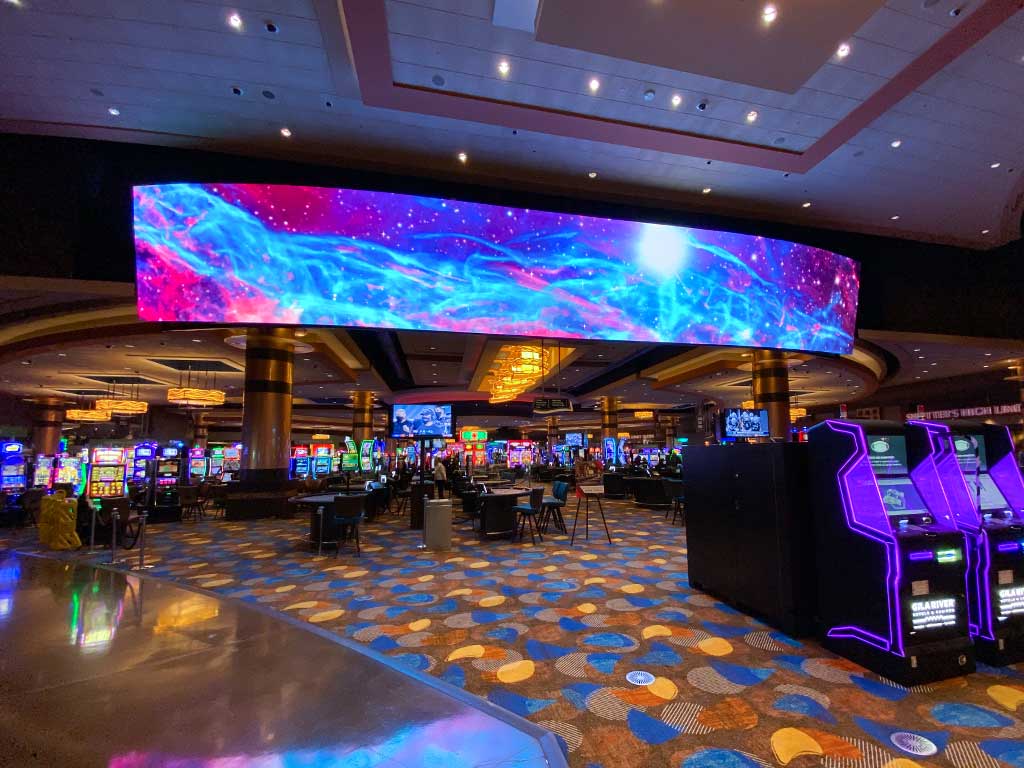
A casino display system has several distinct jobs
A gaming property may combine architectural LED features with practical guest information and live programming. The project works better when each screen has a defined purpose, audience, content owner and operating schedule. That separates brand storytelling from directions, event information and venue-managed live feeds.
Orient guests
Use entrance and circulation displays for property identity, destination cues, event schedules or directions. Keep essential information legible at the time and distance guests need it.
Support venue programming
Screens near bars, restaurants, lounges or sportsbook areas may carry menus, event promotion or live video. Confirm content sources, rights and who operates each feed.
Shape the environment
Overhead ribbons, curved features and large-format walls can extend the venue’s visual identity. Review viewing angles and transitions to adjacent zones before fixing a canvas.
Choose the screen around the location
The same display specification rarely suits every part of a property. Begin with the viewing position and content—not a product label—then compare LED, conventional signage or a mixed system where appropriate.
Gaming floor
Overhead ribbons and feature displays need to be readable from changing positions without overwhelming nearby visual activity. Check ceiling height, viewing angle, reflections and how content behaves at the edges of a curved or segmented layout.
Entry and arrival
A prominent identity display can help establish the venue and support arrival information. Coordinate its scale with the architecture, approach distance, ambient daylight and any existing marquee or wayfinding system.
Sportsbook and live-event zones
Plan for multiple sources, changing schedules and viewing from seats, standing areas and circulation routes. Specify screen grouping, audio coordination and the staff workflow for switching content.
Dining, lounges and resort spaces
Use a smaller, more focused format where guests sit close or need menus and event details. Consider display glare, quiet zones, service access and whether the screen should be visible from adjacent areas.
Set the display format from the room and content
A useful design brief records screen dimensions, closest and farthest viewers, ambient light at different times, content types and mounting constraints. These inputs help the team compare pixel pitch, native resolution and physical format with actual viewing tests.
Viewing distance and text
Fine text, close viewing and detailed graphics place different demands on pixel pitch than distant decorative content. Share real menus, maps, event graphics and video samples so stakeholders can judge legibility at representative distances.
Shape and sightlines
Flat walls, corner wraps, columns, rings and overhead features each affect viewing angles, seam locations and the usable content canvas. Request dimensioned drawings and a pixel map for non-rectangular layouts.
Brightness and image finish
Evaluate the screen under the venue’s real lighting, including reflections and darker operating periods. Agree on a comfortable operating range and content treatment rather than selecting brightness from an isolated maximum figure.
Compare the whole system, not just the LED surface
Ask bidders to identify the display dimensions and pitch, cabinet or module format, processing path, sending/control hardware, content playback, network interfaces and service access. Request sample content on a representative configuration before final approval.
Define how content reaches each zone
Casino LED projects often sit alongside existing AV, signage, IT and venue-management systems. A clear signal-flow diagram avoids confusion about which team supplies, approves, schedules and troubleshoots each source.
List approved sources
Record whether a zone uses scheduled promotions, event calendars, menu content, live video or venue-specific data. For game-related or other operational feeds, identify the approved source system and integration owner during discovery.
Group displays into zones
Map each physical screen to a named content zone and define which displays can be synchronized, switched independently or temporarily taken offline. Document what guests should see during a source or player fault.
Assign publishing permissions
Agree who can create, review, schedule and publish content. Clarify approval steps, operating hours and escalation contacts for urgent changes before choosing the control workflow.
Coordinate AV and IT
Confirm input formats, processor capacity, network paths, remote access, monitoring and cybersecurity review with the property’s teams. Validate the design against the systems they support and permit.
Plan installation around guest operations
A casino installation is a building, AV and operations project as well as a display purchase. Review the route from receiving to final mounting, the work windows available, and how crews can work without obstructing guests or staff.
Structure and access
Provide reflected ceiling plans, mounting surfaces, proposed loads and access constraints for engineering review. Confirm lifting, rigging, service-platform and inspection requirements with qualified local professionals.
Power, data and heat
Coordinate electrical capacity, cable routes, equipment locations, ventilation and ambient conditions early. The AV and electrical teams should confirm the project-specific design and local requirements.
Finish and guest circulation
Check sightlines from seating, gaming positions and walkways; account for columns, lighting and decorative finishes. Plan the installation sequence so temporary barriers and equipment do not compromise guest routes.
Service strategy
Choose front or rear access based on the actual wall, ceiling and rigging conditions. Document replaceable parts, spare inventory, diagnostics, responsible service contacts and permitted maintenance windows.
Make serviceability part of the specification
For a high-traffic venue, the repair path matters as much as the initial image. Ask the supplier to explain how a failed module or receiving component is diagnosed, isolated, replaced and color-matched, and what the property needs to keep on hand.
Access before finishes
Reserve practical access to modules, power supplies, processors and cable connections. A visually clean installation should still allow technicians to reach service points without extensive demolition.
Spare parts and records
Agree on a recommended spare-parts list, labeling, configuration backups and a record of screen maps and signal paths. Keep this documentation with the venue team responsible for future changes.
Operating handover
Include operator training, content templates, source switching, monitoring procedures and escalation contacts in handover. Define who owns each routine task after the integrator leaves.
What drives the total casino LED display cost?
A responsible estimate separates display hardware from the work required to integrate it into a live property. Compare the same scope, assumptions, exclusions and service period across proposals.
Display size and resolution
The screen area, pixel pitch, cabinet format and image requirements influence hardware selection. Curved, transparent or custom-shaped surfaces may require additional design and content mapping.
Structure and installation
Mounting design, architectural coordination, rigging, access equipment, electrical work and installation windows can be major scope items. Request them as explicit line items.
Processing and control
Signal distribution, processors, content players, software, network interfaces and monitoring have different responsibilities and renewal costs. Ask which elements are included and who supports them.
Commissioning and support
Content setup, calibration, operator training, spares, preventive maintenance and response arrangements affect lifecycle cost. Compare support scope and assumptions alongside the initial purchase.
What to prepare before requesting a proposal
A concise, site-specific brief helps suppliers return a meaningful design instead of a generic product quote. Include available drawings and photos, and mark any details that still need a site survey.
Venue and screen locations
Floor plan, elevations, ceiling height, screen dimensions, approach paths, nearest and farthest viewing positions, mounting surfaces and access limitations.
Content and control
Content examples, source list, number of zones, scheduling and approval owners, live-video needs, interfaces, network constraints and desired monitoring responsibilities.
Delivery and service
Project timeline, receiving address, installation windows, property operating constraints, commissioning expectations, training needs, spare-parts expectations and ongoing service contacts.
Before award, request a dimensioned layout, content-resolution map, signal-flow diagram, installation scope, commissioning plan and a written list of exclusions.
Casino LED display questions
What types of LED displays are used in casinos?
Common project types include large-format video walls, overhead ribbons, curved or column displays, entry features and screens for bars or event spaces. The right format depends on the room, viewing positions, content and service access.
How do I choose pixel pitch for a casino floor?
Start with the closest viewing position, the smallest content detail that must remain readable, the screen dimensions and the intended viewing angle. Validate shortlisted pitches with representative content at realistic distances before approval.
Can one system control displays across the property?
A centralized workflow may be possible, but the design should define zones, sources, permissions, network paths and support ownership. Confirm compatibility with the property’s AV, IT and operational systems rather than assuming a universal connection.
What should be included in a casino LED display quotation?
Compare display hardware, mounting and structural work, processors, content playback, signal distribution, installation, commissioning, training, spares and support. Ask suppliers to identify exclusions and site assumptions.
How can maintenance avoid disruption to the venue?
Plan service access and maintenance windows during design. Document fault isolation, spare parts, replacement procedures and escalation contacts, then coordinate work with the property’s operations team.
Plan a casino LED display around the venue
Share a floor plan, intended screen locations, viewing distances, content sources and project timeline. We can review the requirements and outline the information needed for a project-specific proposal.
Discuss your project