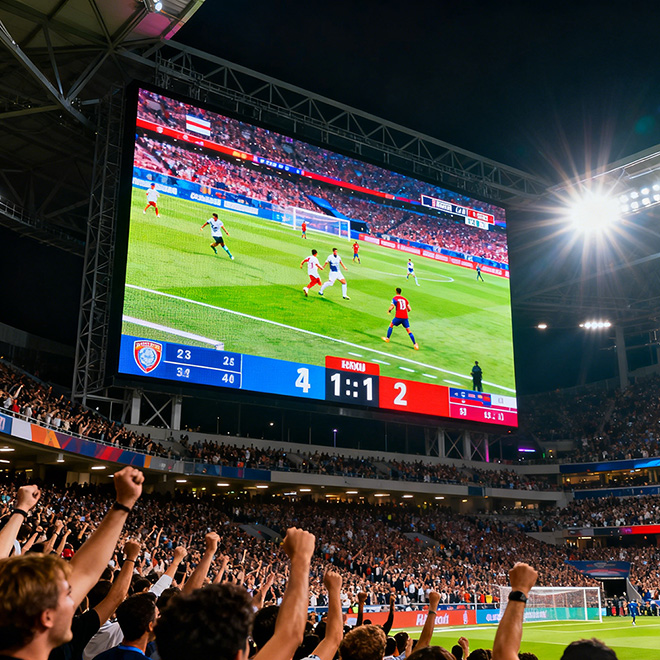
Indoor vs Outdoor LED Displays: The Real Differences You Need to Know
Indoor and outdoor LED displays look similar at first glance – both have black surfaces, both emit bright light, and both show moving images. But underneath the surface, they are engineered for completely different environments. They are not interchangeable. Put an indoor screen outdoors, and one rainstorm will ruin it. Put an outdoor screen in a conference room, and your audience will leave with eye strain and a headache.
Here’s a no‑nonsense breakdown of what really separates them, so you can make the right choice for your project.
Quick Comparison at a Glance
| Feature | Indoor LED | Outdoor LED |
|---|---|---|
| Brightness | 800 – 2,000 nits | 5,000 – 10,000+ nits |
| IP Rating | IP20 – IP43 (no water resistance) | IP65 – IP68 (dust‑tight & waterproof) |
| Pixel Pitch (P‑value) | P0.9 – P3 (fine detail, close viewing) | P4 – P20+ (far distance visibility) |
| LED Packaging | SMD (thin, excellent colour, UV‑sensitive) | DIP or ruggedised SMD (UV‑resistant, sealed) |
| Cooling | Passive convection, low noise | Active fans / AC units, high airflow |
| Weight & Thickness | ~10–20 kg/m², 5–15 mm thick | ~30–80 kg/m², 20–50 mm thick |
| Cost (approx.) | $400 – $1,800 / m² (varies by pitch) | $600 – $2,500+ / m² |
| Rated Lifespan | ~60,000 hours | ~80,000 hours (industrial‑grade) |
| Installation | Wall‑mount, ceiling‑suspend, front‑access | Steel structure, foundations, wind‑rated |
1. Brightness
Indoor screens operate in controlled lighting – offices, malls, conference rooms. Ambient light is 200–500 lux, so 800–2,000 nits is plenty. Higher brightness causes visual fatigue and colour washout.
Outdoor screens face direct sunlight (up to 100,000 lux). They need at least 5,000 nits, often 8,000–10,000 nits to remain readable. Premium models auto‑dim at night to avoid light pollution – a standard feature in 2026.
2. Ingress Protection
Indoor displays have IP20–IP43 – they stop dust but zero water resistance. One heavy rain will short‑circuit driver ICs and LED chips. Outdoor displays must be IP65 or higher – fully dust‑tight and protected against water jets. PCBs get conformal coating against moisture, fungus, and salt spray.
Real‑world fact: An indoor screen installed outdoors without proper enclosure often fails within 3–6 months, despite a rated life of 5–8 years.
3. Pixel Pitch
Pixel pitch (P‑value) is the distance between adjacent pixels in millimetres. Smaller pitch = finer image.
- Indoor: P0.9–P3 – viewed from 1–3 metres – 4K/8K clarity.
- Outdoor: P4–P20+ – viewed from 10–100+ metres – larger pixels save cost without sacrificing perceived quality.
4. Packaging and Materials
Indoor screens use SMD (Surface‑Mounted Device) – tiny, wide‑angle, excellent colour, but vulnerable to UV and moisture. Outdoor screens use DIP (Dual In‑line Package) or reinforced SMD – larger, resin‑encapsulated, able to withstand –30°C to +60°C and years of sun exposure.
Cabinets: indoor = lightweight aluminium/plastic (5–15 mm thick); outdoor = heavy steel/die‑cast aluminium (20–50 mm), corrosion‑coated.
5. Cooling and Installation
Indoor screens generate 100–300 W/m² – passive convection suffices. Installation is quick: wall‑mount, hang, or recess. Magnetic front‑access modules allow one‑person maintenance.
Outdoor screens consume 800–1,200 W/m² – under summer sun, cabinet temps hit 60–70°C. They require active cooling (fans, heat sinks, even built‑in AC). Installation needs heavy steel structures, concrete foundations, and wind resistance (typhoon‑grade).
6. Cost and Energy
Outdoor screens cost 20–30% more per m² and consume 2–3× more electricity. However, they last longer (~80,000 h vs. 60,000 h) thanks to industrial components.
Don’t try to save money by adding a simple roof to an indoor screen – humidity, dew, and thermal cycling will still destroy it quickly. And don’t buy an outdoor screen for a quiet boardroom – you’ll overpay and annoy everyone with fan noise.
7. Common Mistakes
- ❌ “A canopy makes indoor screen outdoor‑ready.” – No, it blocks rain but not humidity, UV, or condensation. Failure within months.
- ❌ “Higher brightness is always better.” – Indoors, excessive brightness strains eyes and washes out colours. Match to ambient light.
- ❌ “IP rating doesn’t matter under a roof.” – Even semi‑outdoor areas have wind‑blown dust and condensation. Choose at least IP54.
Choose by Environment, Not by Looks
Indoor displays prioritise image quality, comfort, and aesthetics – they’re made for close, long‑term viewing. Outdoor displays are built for durability, visibility, and reliability – they must survive weather, sun, and vandals while delivering a clear message.
Two simple questions to start:
① Where will it be installed? (indoor / outdoor / semi‑outdoor)
② What is the typical viewing distance?
Then match pitch and brightness accordingly. Don’t fall for one‑size‑fits‑all marketing. A well‑chosen screen serves you for years; a mismatched one becomes a costly paperweight.
Get Our Latest Products & News
Subscribe to our newsletter for fresh product launches, industry insights, and exclusive offers tailored for global partners. Stay ahead with updates that matter to your business!