LED Display Pixel Pitch: The Complete Guide
Pixel pitch is the most fundamental specification for any LED display. It determines resolution, viewing distance, image quality, and cost. This guide covers everything from measurement to selection.
What is LED Display Pixel Pitch and How Is It Measured?
Distancia entre píxeles is the distance from the center of one LED cluster (pixel) to the center of the adjacent pixel, measured in millimeters (mm). It directly defines the pixel density and therefore the sharpness of the image. A smaller pixel pitch means more pixels per unit area, resulting in higher resolution and finer detail.
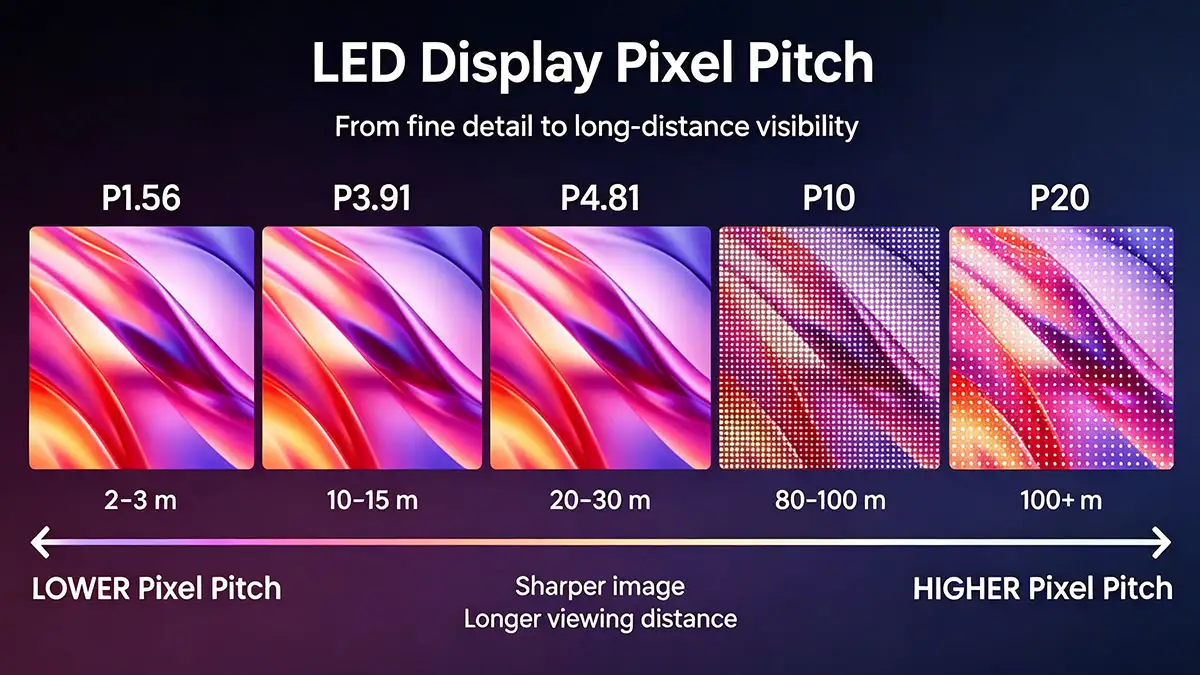
To measure pixel pitch physically, take a ruler and measure the distance between the centers of two adjacent pixels on the display surface. For example, if the distance is 2.9 mm, the display is a P2.9 model. This measurement is standard across the industry and appears in every product datasheet.
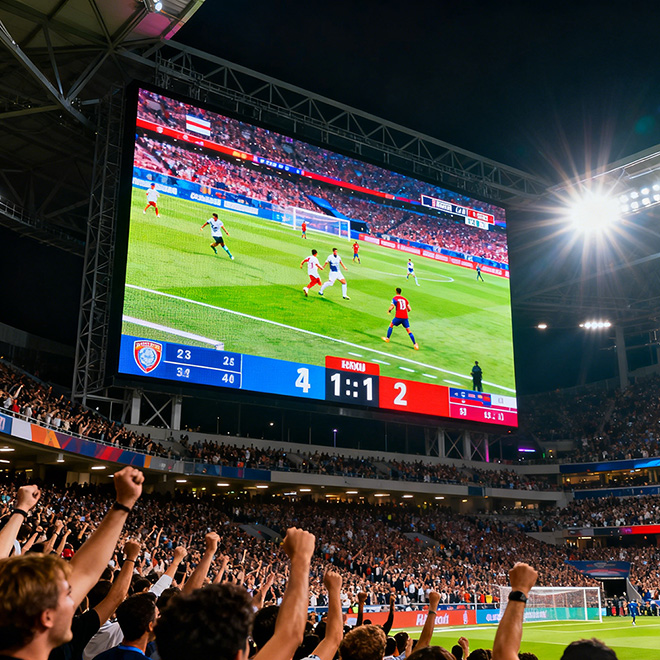
Pixel pitch matters because it determines the minimum viewing distance for a seamless image. If you stand too close to a large-pitch display, you will see individual pixels (the “screen door effect”). Conversely, a very small pitch is wasted if the display is viewed from far away, as the human eye cannot resolve the extra detail.
This section answers: “What is Pixel Pitch and Why Does It Matter?”
Choosing the Right Pixel Pitch: Formulas, Viewing Distance, and Worked Examples
Selecting the correct pixel pitch involves calculating the required pixel density and matching it to the viewing distance. The fundamental formula is:
Pixels per meter = 1000 / pixel pitch (mm)
For example, a P2.9 display has 1000 / 2.9 ≈ 345 pixels per meter. A P10 display has 100 pixels per meter.
To calculate total resolution for a given screen size:
Horizontal pixels = (width in meters) × (1000 / pitch in mm)
Vertical pixels = (height in meters) × (1000 / pitch in mm)
Worked Example 1: How many pixels is a 2.9 mm LED screen?
For a 2.9 mm pitch screen measuring 3 meters wide by 1.5 meters high:
- Horizontal pixels = 3 × (1000 / 2.9) = 3 × 345 ≈ 1,035 pixels
- Vertical pixels = 1.5 × (1000 / 2.9) = 1.5 × 345 ≈ 517 pixels
- Total pixels = 1,035 × 517 ≈ 535,000 pixels
Worked Example 2: 6m x 3.4m screen with P4 pitch
- Pixels per meter = 1000 / 4 = 250 px/m
- Horizontal = 6 × 250 = 1,500 pixels
- Vertical = 3.4 × 250 = 850 pixels
- Total = 1,500 × 850 = 1,275,000 pixels
Recommended viewing distance: A common rule of thumb is that the optimal viewing distance (in meters) is approximately 2.5 to 3 times the pixel pitch (in mm). For a P2.9 display, this is 7.25 to 8.7 meters. For a P10 display, it is 25 to 30 meters. This ensures the pixels blend into a smooth image.
| Distancia entre píxeles (mm) | Pixels per Meter | Recommended Viewing Distance (m) | Typical Application |
|---|---|---|---|
| P1.2 | 833 | 3 – 4 | Indoor, close viewing |
| P2.5 | 400 | 6 – 8 | Indoor, retail, control rooms |
| P4 | 250 | 10 – 12 | Indoor/outdoor, mid-distance |
| P6 | 167 | 15 – 18 | Outdoor, medium to large |
| P10 | 100 | 25 – 30 | Outdoor billboards, large venues |
This section answers: “How many pixels is a 2.9 mm LED screen?”, “How Do You Choose the Right Pixel Pitch for an LED Video Wall?”, and “How to select pixel pitch for active led video wall?”
How Pixel Pitch Interacts with Image Quality, Brightness, Contrast and LED Technologies
Pixel pitch has a direct impact on perceived image quality. Smaller pitch delivers sharper images, finer text, and smoother edges. However, it also affects other performance parameters.
Brightness and contrast: Smaller pixel pitch means more LEDs per area, which can increase the potential brightness (more emitters). However, the smaller size of individual LEDs in fine-pitch displays may limit the maximum achievable brightness compared to larger-pitch outdoor LEDs. Contrast is often improved with smaller pitch because the black area between pixels (the “fill factor”) is reduced, making dark scenes appear deeper.
Apparent pixel structure: At close distances, a large pitch display shows visible grid lines or pixel outlines. This is measured as the “pixel fill factor” or “surface coverage ratio.” A higher fill factor (e.g., >90%) means the pixels appear more continuous and less structured, which is critical for high-end indoor displays.
SMD vs. DIP technologies:
- SMD (Surface-Mount Device): LEDs are mounted directly on the circuit board. This allows for very small pixel pitches (down to P0.7) and is the standard for indoor and fine-pitch displays. SMD offers better color mixing, wider viewing angles, and easier calibration.
- DIP (Dual In-line Package): LEDs are encased in a plastic shell with two leads. This technology is limited to larger pitches (typically P6 and above) due to the physical size of the package. DIP displays are more robust, have higher brightness, and are less expensive for large outdoor installations, but they have poorer color uniformity and are harder to repair at the pixel level.
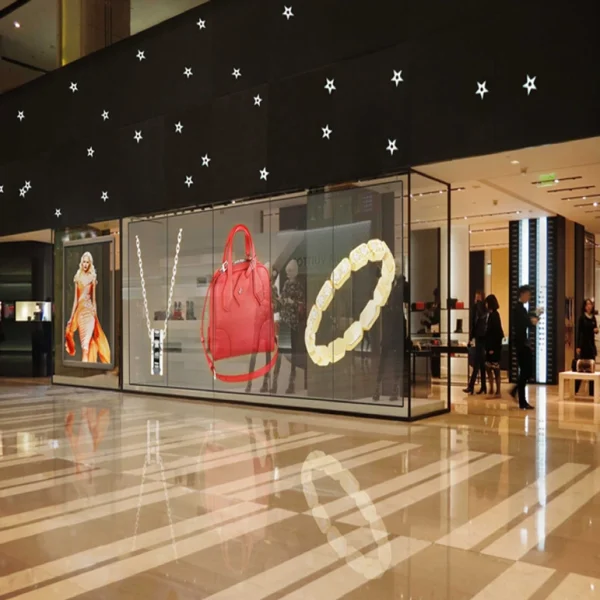
Curved and transparent displays: For curved screens, pixel pitch must be consistent along the curve to avoid distortion. Transparent LED displays often use larger pitches (P10–P20) to allow light to pass through, but they can also use smaller pitches (P3.9–P7.8) with special transparent substrates. The pitch choice affects the level of transparency and resolution trade-off.
Environmental ratings (IP): Outdoor displays with IP65/IP66 ratings often use larger pitches because the protective encapsulation adds to the pixel size. Fine-pitch outdoor displays (P3–P6) are available but require more sophisticated waterproofing.
Costs, Maintenance, Specs, and Practical Selection Checklist
Pixel pitch is the largest cost driver for LED displays. Smaller pitch means more LEDs, more driver ICs, and more complex manufacturing, which increases the price per square meter.
Cost estimation ranges (2025 market, USD per m²):
| Distancia entre píxeles | Typical Cost (USD/m²) | Typical Use |
|---|---|---|
| P1.2 – P1.5 | $2,500 – $5,000+ | High-end indoor, control rooms |
| P2.5 – P3.9 | $1,200 – $2,500 | Retail, corporate, events |
| P4 – P6 | $600 – $1,200 | Outdoor, mid-distance |
| P8 – P10 | $300 – $600 | Large outdoor billboards |
Maintenance and lifespan: Fine-pitch displays have more components, so the statistical chance of pixel failures is higher. However, modular design allows individual module replacement. Calibration frequency is generally every 6–12 months for professional installations. Large-pitch displays (P6+) are more forgiving and require less frequent calibration.
Minimum pixel pitch for HD video: To display 1080p (Full HD) content natively, the screen must have at least 1920 horizontal pixels. For a 4-meter-wide screen, this requires a pixel pitch of 1000 × 4 / 1920 ≈ 2.08 mm. For 720p, a 2.8 mm pitch would suffice for the same width.
Manufacturer lead times: Standard pitches (P2.5, P4, P5, P10) are often in stock with lead times of 2–4 weeks. Custom pitches or very small pitches (under P1.5) may require 6–10 weeks for manufacturing and calibration.
Conversion chart: mm to dpi/ppi: Pixels per inch (PPI) = 25.4 / pitch (mm). For P2.9, PPI = 25.4 / 2.9 ≈ 8.8 PPI. For P10, PPI = 2.54 PPI. This is much lower than a smartphone (300+ PPI) because LED displays are viewed from a greater distance.
Selection checklist:
- Define the viewing distance range.
- Calculate required pixel density using the 2.5× pitch-to-distance rule.
- Determine screen dimensions and calculate total pixels needed.
- Match to available content resolutions (720p, 1080p, 4K).
- Consider environment: indoor (small pitch) or outdoor (IP rating, brightness).
- Evaluate technology: SMD for fine pitch, DIP for large outdoor.
- Request quotes from at least 3 suppliers with warranty and support details.
Next Steps
To make the right pixel pitch decision, download our Pixel Pitch Calculator (Excel tool with distance and resolution formulas), request a free visualization mockup of your content at different pitches, or schedule a technical consultation to review your project specifications. We provide custom quotes with three recommended configurations and cost estimates within 48 hours.
Preguntas frecuentes
How many pixels is a 2.9 mm LED screen?
A P2.9 screen has approximately 345 pixels per meter horizontally and vertically. For a 3m x 1.5m screen, the total resolution is about 1,035 x 517 pixels (535,000 total pixels). Use the formula: pixels = (width in m) × (1000 / pitch in mm).
What is Pixel Pitch and Why Does It Matter?
Pixel pitch is the center-to-center distance between adjacent pixels, measured in millimeters. It matters because it determines the resolution, optimal viewing distance, and cost of the display. Smaller pitch means sharper images but higher cost and is required for close viewing.
How Do You Choose the Right Pixel Pitch for an LED Video Wall?
Calculate the viewing distance, then choose a pitch such that the distance in meters is 2.5 to 3 times the pitch in mm. Match the resulting pixel count to your content resolution. For example, for a 5m viewing distance, a P2 to P2.5 pitch is recommended.
How to select pixel pitch for active led video wall?
For active video walls (where content is dynamic and includes text or fine details), choose a pitch that provides at least 1.5 times the pixel density required for the closest viewer. This ensures text is crisp and motion is smooth. Always consider the viewing angle and ambient light.
What is the minimum pixel pitch needed for HD (720p/1080p) video on an LED wall?
For 1080p, the screen must have at least 1920 horizontal pixels. For a 4m wide screen, the pitch must be ≤ 2.08 mm. For 720p, 1280 horizontal pixels are needed; for the same width, pitch ≤ 3.1 mm.
How do I convert pixel pitch in millimeters to PPI/dpi?
Use the formula: PPI = 25.4 / pitch (mm). For P2.9, PPI = 8.8; for P10, PPI = 2.54. This is useful for comparing to other display technologies like LCD monitors.
What are the differences between SMD and DIP LED technologies and how do they affect pixel pitch choices?
SMD (Surface-Mount) LEDs allow very small pitches (down to P0.7) and are used for indoor, fine-pitch displays. DIP (Dual In-line) LEDs are larger and limit pitch to P6 and above, but offer higher brightness and durability for outdoor use. SMD provides better color and viewing angles; DIP is more robust and cost-effective for large outdoor screens.
Entérate de nuestros últimos productos y novedades
Suscríbete a nuestro boletín para recibir información sobre nuevos lanzamientos de productos, análisis del sector y ofertas exclusivas diseñadas para socios de todo el mundo. ¡Mantente a la vanguardia con las novedades que importan para tu negocio!