Church LED Display: Complete Buying & Installation Guide for Worship Spaces
Church LED Display Options: Indoor Walls, Stage Screens, Outdoor Signs, and More
Every worship space has unique visual needs, and a church LED display delivers flexible content for all types of church gatherings. There are several core church LED display formats built to fit small chapels, mid-sized sanctuaries, large megachurch auditoriums, and multi-campus ministry groups.
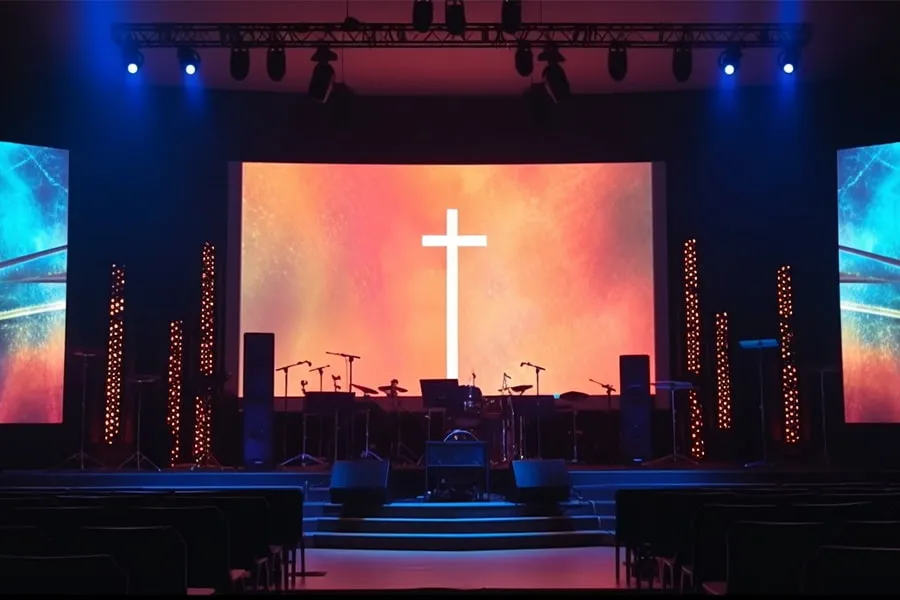
Indoor church LED video walls remain the most popular investment, split into main stage backdrops, side auxiliary screens, and compact pulpit announcement displays. These church LED display systems handle worship lyric projection, scripture verses, sermon notes, event announcements, and live camera feeds during services. Many congregations also add exterior church LED signs mounted above entryways, used to share service times, holiday events, community outreach messages, and welcome signage for passersby.
Temporary rental church LED display panels serve seasonal events like holiday pageants, outdoor baptism services, and traveling ministry conferences, eliminating the upfront cost of permanent hardware. Congregations can also explore pre-owned church LED display units or fully custom-shaped LED walls designed to match unique sanctuary architecture, such as curved stage backgrounds or pillar-mounted auxiliary screens.
Smaller churches with limited square footage often rely on narrow, compact church LED display pulpit screens, while large sanctuaries install wide-format stage LED walls to ensure every seat has clear visibility. No matter the congregation size, a properly matched church LED display streamlines worship visuals and creates a more immersive atmosphere for corporate worship.
How to Choose the Right Church LED Screen: Size, Viewing Distance, Resolution, and Pixel Pitch
Many ministry leaders search for clear guidance on how to choose a church LED screen that balances readability, broadcast quality, and budget. Four core factors shape every functional church LED display: sanctuary dimensions, minimum and maximum viewing distances, screen aspect ratio, and pixel pitch rating.
The basic rule for any church LED display is simple: shorter viewing distances require smaller pixel pitch values to keep song lyrics and scripture text sharp. For front-row seats within 3 meters of the screen, P1.8 or P2 church LED display panels eliminate blurry lettering. Congregants seated 4 to 8 meters away work best with P2.5 or P3 panels, while extra-large sanctuaries with rear seating over 10 meters from the stage can reliably use P3.91 without sacrificing text clarity.
Screen sizing must align with the sanctuary’s width and ceiling height. A church LED display that spans too narrow a frame forces distant attendees to strain to read text, while an oversized wall can overwhelm small worship spaces. Most worship teams select a 16:9 widescreen aspect ratio to match standard worship software and live camera broadcast formats, avoiding awkward letterboxing during live stream recording.
Live recording is another key consideration for a church LED display. Smaller pixel pitches produce crisp, flicker-free footage when captured by sanctuary cameras, a critical detail for ministries that stream services to online viewers. The table below offers quick pixel pitch recommendations sorted by average viewing distance:
View Distance 0–3m: P1.8 / P2 | View Distance 3–8m: P2.5 / P3 | View Distance 8–15m: P3.91 / P4
Before finalizing a church LED display order, measure the furthest occupied pew, confirm ceiling rigging limits, and prioritize text legibility over maximum screen size to avoid wasted investment.
Church LED Display Cost: Pricing Ranges, Budget Tiers, and Financing Options
When researching church LED display cost, congregations often make the mistake of only comparing raw panel pricing. The full total investment of a church LED display includes dozens of additional line items that many low-ball supplier quotes omit upfront.
Complete church LED display packages factor in LED modules, receiving cards, video processors, rigging brackets or wall mounting frames, structural reinforcement for overhead installation, upgraded electrical wiring, dedicated control computers, licensed worship display software, signal cabling, professional on-site installation, staff training sessions, multi-year warranty coverage, and spare replacement panels for long-term maintenance.
Budget tiers break down clearly by congregation size. Small chapel church LED display setups for under 150 attendees carry a mid-range entry budget focused on compact P2.5 pulpit or stage screens. Mid-sized sanctuaries for 200–600 worshippers require wider P2/P2.5 stage LED walls with full AV integration. Large megachurch church LED display systems for over 800 attendees include ultra-fine pitch multi-panel video walls, dedicated broadcast processing, and reinforced ceiling rigging for heavy screen loads.
Ministries have multiple flexible financial pathways to cover church LED display cost. Short-term rental church LED display panels cut upfront spending for seasonal events only. Certified used church LED display hardware offers 30–50% cost reduction for congregations willing to accept shorter warranty windows. Many LED manufacturers offer church-specific financing plans with low monthly payments, while leadership teams can also launch targeted capital campaign fundraisers to split the project cost across parishioner donations.
It is vital to compare full turnkey project quotes instead of per-square-meter panel rates. A cheap church LED display without included installation, training, or spare parts often carries far higher long-term total ownership cost.
LED Wall vs Projector vs LCD Video Wall for Churches
Three primary visual solutions compete for worship spaces: church LED display walls, standard projectors, and LCD splicing video walls. A side-by-side comparison reveals clear use cases for each option, helping ministry teams avoid mismatched hardware purchases.
Projectors remain the lowest upfront cost option, but they struggle in bright sanctuaries with large windows or overhead stage lighting. Strong ambient light washes out projected text, making worship lyrics unreadable for attendees. They also rely on replaceable bulbs or laser components with limited lifespans, and projected images cannot deliver crisp quality for high-definition live streaming.
LCD video walls use thin flat panels linked together, most suitable for quiet lobbies, overflow rooms, or narrow announcement displays. Visible bezels between each LCD panel break up text and imagery, making them a poor fit for main stage worship visuals that require seamless, unified lyric display. Their maximum scalable size is also limited compared to a modular church LED display wall.
A church LED display solves the core pain points of both alternatives. It delivers high nits brightness that cuts through full sanctuary lighting with zero washout, fully seamless modular panels with no dividing lines, and unlimited expandable sizing to fill entire stage backdrops. LED walls produce smooth, flicker-free video ideal for live streaming and recorded sermons, with far longer component lifespans than projector bulbs. The only tradeoff is higher initial cost, offset by minimal recurring maintenance fees year over year.
For most active worship services with full lighting and live broadcast goals, a church LED display is the most functional long-term visual investment.
Indoor Church LED Display Installation, AV Integration, Maintenance, and Support
Successful long-term operation of an indoor church LED display relies on thorough pre-install planning, full AV system integration, and consistent scheduled maintenance, details many suppliers overlook during initial sales conversations.
Installation teams must first complete structural safety checks, including wall weight load testing and ceiling rigging certification for overhead hung church LED display walls. The project requires upgraded dedicated electrical circuits to handle the screen’s power draw, plus built-in ventilation and heat dissipation systems to prevent overheating during multi-hour worship services. Installers also reserve accessible service channels for front or rear panel maintenance and adhere to local building fire and safety codes for public assembly spaces.
Seamless AV integration is non-negotiable for any functional church LED display. All top worship software platforms including ProPresenter and Resolume fully sync with modern LED video processors, supporting scripture libraries, lyric slide decks, pre-recorded sermon clips, and live camera switcher feeds. Technicians route audio and video signals to eliminate lag between stage microphones and on-screen text, and provide hands-on volunteer training to simplify weekly service operation workflows.
Routine maintenance extends the lifespan of every church LED display. Monthly visual inspections catch dead pixels or dimming modules early, while quarterly color calibration ensures consistent brightness across the entire wall. Reputable suppliers include multi-year warranties and stock spare LED panels for fast on-location repairs. Congregations should confirm their vendor provides dedicated technical support SLAs, emergency troubleshooting hotlines, and references from other completed church LED display sanctuary projects before signing a purchase contract.
Ready to receive a custom church LED display solution tailored for your worship space? Submit details about your sanctuary floor plan, average viewing distances, target budget range, and existing AV equipment inventory to our technical team. We offer complimentary space assessments, pixel pitch sizing recommendations, full turnkey budget quotes, installation safety feasibility reviews, and flexible financing guidance for ministry groups of all sizes.
Share photos of your stage, pew layout, and current lighting setup to receive a fully customized church LED display layout design, rather than generic one-size-fits-all hardware pricing. Our team also provides volunteer training roadmaps and long-term maintenance planning to keep your worship visuals reliable for every service.
Preguntas frecuentes
How to choose church LED screen?
Start by measuring minimum and maximum viewing distances inside your sanctuary to select the correct pixel pitch, then calculate your ideal screen width based on stage dimensions and congregation capacity. Prioritize lyric readability and live streaming compatibility when comparing church LED display models.
How much does a church LED display cost?
Total project pricing depends on pixel pitch, screen dimensions, rigging, AV integration, installation labor, and warranty coverage. Small chapel setups carry a modest entry budget, while large multi-wall sanctuary systems require a full turnkey investment; financing and rental options lower upfront costs for ministries.
What is the best LED display size for a church sanctuary?
Match screen width to your stage footprint, and scale height to ensure attendees in the furthest pews can read text without strain. Avoid oversized walls for compact chapels, and opt for wide-format 16:9 sizing compatible with worship software and live streaming.
What pixel pitch is best for a church LED wall?
P1.8–P2 works for seating within 3 meters of the screen, P2.5–P3 suits mid-range viewing distances of 3–8 meters, and P3.91/P4 fits extra-large sanctuaries with rear seating further than 8 meters away.
Is a church LED display better than a projector?
For bright sanctuaries with live streaming needs, a church LED display outperforms projectors by eliminating light washout and delivering crisp, seamless visuals. Projectors only work well for dim, low-attendance chapels with no regular video recording.
Can a church LED display work with ProPresenter and other worship software?
All modern church LED display video processors offer full native compatibility with ProPresenter, Resolume, and major worship media servers, supporting synchronized lyric slides, scripture, and live camera feeds without signal lag.
Should a church rent or buy an LED display?
Rental church LED display panels are ideal for one-off seasonal events or short-term outreach gatherings. Permanent purchase delivers better long-term value for weekly recurring worship services, with financing plans available to split project costs over time.
What maintenance does a church LED display need?
Schedule monthly visual pixel inspections, quarterly color calibration, and annual cable and power supply checks. Source spare replacement modules from your supplier to minimize downtime if individual panels require repair.

Entérate de nuestros últimos productos y novedades
Suscríbete a nuestro boletín para recibir información sobre nuevos lanzamientos de productos, análisis del sector y ofertas exclusivas diseñadas para socios de todo el mundo. ¡Mantente a la vanguardia con las novedades que importan para tu negocio!