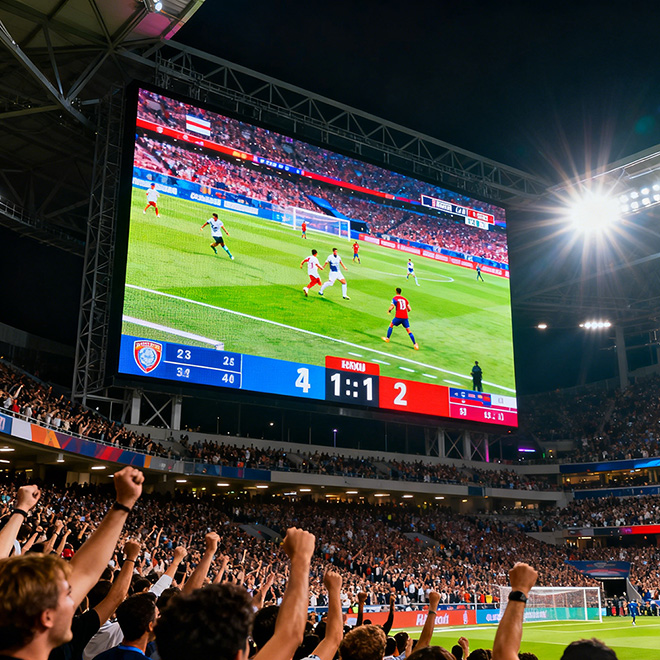
LED Display Aspect Ratio: The Complete Guide to Sizing, Resolution & Content Mapping
Standard vs. Legacy: Understanding 4:3, 16:9, and the Rise of Widescreen LED
In the early days of projection and CRT monitors, the 4:3 aspect ratio (1.33:1) was the de facto standard. It is slightly taller than wide and was originally derived from motion picture film formats from the 1940s. In LED displays, you will still encounter 4:3 configurations in legacy boardrooms, older church sanctuaries projecting song lyrics, or specialized medical imaging where a vertical bias helps with document/form viewing. However, 4:3 has largely been superseded in commercial AV by 16:9 (1.78:1), the international high-definition widescreen standard.
So, what does a 16:9 ratio mean for an LED video wall? It means for every 16 units of width, the height measures 9 units. A 1920×1080 Full HD image is 16:9; so is 3840×2160 (4K UHD). When you specify a 16:9 LED wall, you are asking for a physical rectangle whose width-to-height proportion matches these resolutions, ensuring native content plays without black bars or cropping.
In the U.S. market, 16:9 has become the default for corporate conference rooms, higher education lecture halls, and digital signage in hospitality because it aligns perfectly with PowerPoint presentations, Zoom/Teams layouts, broadcast feeds, and YouTube advertising loops. A 16:9 wall allows a marketing director to push branded video content straight from a laptop without re-encoding. That said, 4:3 is not extinct—certain courtroom evidence displays, legacy control room monitors, and some classroom podiums still favor it for text-heavy slide decks originally authored in 1024×768.
The industry-wide shift to 16:9 is also driven by modular cabinet standardization. Most modern die-cast aluminum cabinets (e.g., 500×281mm or 960×540mm) are themselves 16:9 proportions, making it far easier to build a native 1080p or 4K wall by simply tiling identical panels. Choosing 16:9 future-proofs your investment; choosing 4:3 today usually implies a niche functional requirement rather than a general display need.
The Math Behind the Panel: Calculating Resolutions and Avoiding Distortion
One of the most common—and costly—mistakes in LED specification is ordering a wall whose physical dimensions do not match the aspect ratio of the intended source content, resulting in stretched images or forced black pillarbox bars. Here is the practical math every AV buyer should know.
Step 1 – Determine Physical Dimensions in Inches/Feet:
Let’s say you have a wall cavity 13 feet 6 inches wide (162 inches) and you want a floor-to-ceiling height of 7 feet 6 inches (90 inches).
Step 2 – Check Native Aspect Ratio:
162 ÷ 90 = 1.8 — this is very close to 16:9 (1.777…). It is a safe 16:9 fit with minimal adjustment.
Step 3 – Calculate Pixel Count Using Pixel Pitch (P-value):
If you choose P2.5 (2.5 mm between pixel centers):
Width in pixels = 162″ × 25.4 mm/inch ÷ 2.5 mm = 1,645 px
Height in pixels = 90″ × 25.4 mm/inch ÷ 2.5 mm = 914 px
These numbers are then rounded to the nearest whole module resolution to determine the exact cabinet count.
Step 4 – Verify Against Standard Resolutions:
A true 1080p (1920×1080) wall at P2.5 would be:
Width = 1920 × 2.5 mm = 4,800 mm = 15.75 ft
Height = 1080 × 2.5 mm = 2,700 mm = 8.86 ft
If your available space is 13.5 ft wide, a 1080p wall won’t fill it. You could either accept pillar bars, crop content, or scale to a custom resolution (e.g., 1640×922) mapped via the video processor.
Golden Rule: Always confirm the native pixel matrix of the assembled cabinets before finalizing content. A mismatch—such as feeding 1920×1080 into a 1920×960 wall—forces the processor to either letterbox or stretch, both of which compromise image fidelity. Your LED vendor should provide a “Pixel Map Drawing” showing exact W×H pixel totals.
| Content Standard | Aspect Ratio | Resolution | Typical LED Application |
|---|---|---|---|
| HD / Full HD | 16:9 | 1920 × 1080 | Corporate Boardrooms, Hotels, Houses of Worship |
| 4K UHD | 16:9 | 3840 × 2160 | Executive Briefing Centers, Broadcast Studios |
| XGA (Legacy) | 4:3 | 1024 × 768 | Older Classrooms, Courtroom Evidence Screens |
| CinemaScope (Anamorphic) | ~21:9 | 2560 × 1080 / 3840 × 1600 | Premium Home Theater, Themed Entertainment Pre-show |
Mapping Content to Any Canvas: Scaling Strategies for Non-Standard LED Walls
Architectural constraints, branding goals, or creative directors often demand LED walls that are not 16:9—for example, a 3:1 panoramic lobby wall or a 9:16 portrait retail banner. The challenge then becomes: how do you show standard 16:9 video without distorting it?
There are three accepted strategies, typically executed inside the video processor (NovaStar, Brompton, Colorlight) or media server (Resolume, Watchout):
1. Letterbox / Pillarbox (Preserve Aspect Ratio):
The 16:9 content is scaled to fit the taller or narrower dimension of the wall, with blank space (black bars) filling the剩余 area. This is safest for brand integrity—logos and people are never stretched—but may leave unused LED surface if clients dislike dark margins.
2. Crop / Pan & Scan:
The content is scaled to fill the wall horizontally, and the top/bottom are cropped. This works well for scenic footage (oceans, city timelapses) but can cut off captions or lower-thirds. Always confirm with the content owner before committing to crop.
3. Content Reframing / Multi-Zone Layout:
The most professional solution for permanent installs. The 16:9 video is placed in one zone, and supplementary graphics, live data, or brand elements occupy the remaining canvas. For instance, a 3:1 lobby wall might show a 16:9 hero video on the left two-thirds and a live social media feed or wayfinding info on the right third. This requires custom templates but maximizes every pixel.
In U.S. retail and casino environments, creative mapping is standard. A Las Vegas sportsbook may run a 5:1 LED ribbon where the center region displays live odds in a 16:9 box and the flanking LEDs scroll sponsor animations. The video processor handles the layer compositing; your job is to define the pixel-coordinate mapping (e.g., “Input 1920×1080 maps to Output pixels 640–2559 on a 7680×1440 wall”).
Breaking the Rectangle: Creative Aspect Ratios for Curved, Transparent, and Irregular LED Displays
Not all LED surfaces are planar rectangles. Cylindrical columns wrapped in flexible LED strips, transparent glass-mounted SMD strips, concave/convex stage backdrops, and free-form artistic arrays all challenge traditional aspect ratio thinking.
For curved and cylindrical walls, the “aspect ratio” is often expressed as the arc length versus the height. A 20-foot circumference × 8-foot tall cylinder is functionally a 20:8 (2.5:1) wraparound canvas. Content is usually authored as a continuous panoramic strip (e.g., 5760×1080 for three 1920px segments edge-blended). The key design constraint is the module chord width—the physical width of each curved module—which determines how smoothly the arc approximates a true circle without visible facet lines.
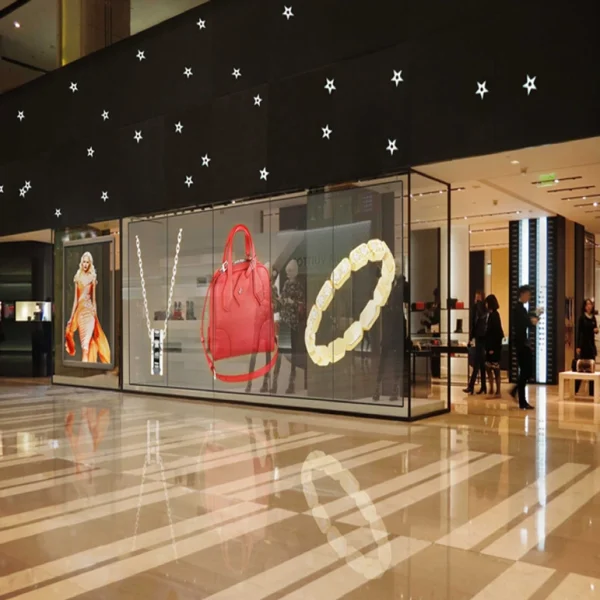
Transparent LED façades (common in U.S. flagship retail like Nike or Samsung Experience Stores) typically use a very wide, short aspect ratio per strip bank—sometimes 16:1 or greater—because the glass curtain wall is tall but the LED strips are spaced vertically with gaps. The “ratio” here is less about content shape and more about pixel density per linear foot and transparency percentage (usually 60–85%).
Iconic U.S. examples include the MSG Sphere in Las Vegas, whose interior LED surface is a fully immersive 360° envelope—content is mapped in equirectangular or dome-master formats, not simple 16:9. Similarly, Coachella’s main stage often deploys massive convex curved LED wings that extend the central 16:9 screen to a super-wide format (approx. 32:9) for audience sightlines on the far wings.
When specifying irregular layouts, think in total pixel canvas rather than aspect ratio alone. A stage rental designer might combine a central 16:9 IMAG screen with two 9:16 side wings for lyric/programming—the overall system is a custom pixel map, not a single ratio.
Industry Verticals and Viewer Psychology: How Aspect Ratio Shapes the American Audience Experience
Aspect ratio is not just geometry—it influences how information is consumed and how audiences feel.
Corporate & Education (16:9 dominance):
PowerPoint and Keynote slides are natively 16:9. Deviating forces presenters to reformat or accept awkward black bars. In U.S. boardrooms, a properly proportioned 16:9 wall signals technological competence and avoids fumbling during client pitches.
Retail & DOOH (Portrait / 9:16 rising):
Times Square is famous for its towering vertical LED spectaculars. Portrait orientation (9:16 or 3:4) mimics the smartphone experience and allows full-body model shots or stacked ad messages. Shoppers glance upward; a vertical canvas captures attention faster than a low, wide banner in a narrow sidewalk frontage.
Broadcast & Virtual Production (16:9 → Ultra-Wide):
Traditional news remains 16:9, but Hollywood virtual production stages (e.g., ILM StageCraft / Disney+ Mandalorian backlots) use expansive curved LED volumes with effective aspect ratios of 21:9 to 32:9 to provide peripheral illumination and camera pan room without green-screen. The psychological effect is heightened immersion—subjects feel “inside” the environment rather than in front of a monitor.
Worship & Live Events:
Many modern megachurches in the U.S. still run dual-side IMAG screens in 16:9, but some are adopting 16:10 or wider center screens flanked by lyric wings. The psychology here is inclusive focus—keeping eyes forward and engaged.
Looking ahead, MicroLED and fine-pitch COB walls will make arbitrary pixel canvases cheaper to produce, accelerating the trend toward content-driven proportions rather than forcing content to fit a standard ratio. Savvy specifiers already ask: “What ratio best serves the message?”—not just “What cabinets are in stock?”
Get a Custom Aspect Ratio Plan for Your LED Video Wall
Choosing the wrong aspect ratio can waste pixels, distort your brand, or force expensive content rework. Our U.S.-based design team provides complimentary pixel-map calculations, 3D render mockups, and content-mapping recommendations tailored to your exact wall dimensions and use case—whether that’s a strict 16:9 4K boardroom wall, a portrait retail banner, or a sweeping curved stage backdrop.
Contact us today for a free LED aspect ratio consultation and receive a detailed cabinet layout with native resolution callouts before you buy.
자주 묻는 질문
What does a 16:9 aspect ratio mean for an LED screen?
It means the screen’s width is 16 units for every 9 units of height (1.777:1). On an LED video wall, this matches HD (1920×1080) and 4K UHD (3840×2160) content, allowing standard video and presentations to fill the screen without stretching or black bars.
Is 4:3 or 16:9 the better aspect ratio for modern LED displays?
For virtually all new commercial, educational, and house-of-worship installs, 16:9 is the better choice because it matches modern laptops, broadcast, and digital signage content. 4:3 is only recommended if you are exclusively displaying legacy XGA presentation material or require a slightly taller image for text documents in a confined space.
How do I calculate the native resolution of an LED display using pixel pitch and physical dimensions?
Convert the physical width and height to millimeters, then divide each by the pixel pitch (in mm). For example, a 4,000 mm wide wall at P2.5 = 4,000 ÷ 2.5 = 1,600 pixels wide. Repeat for height. Round to the nearest full module pixel count to get the actual native resolution of the assembled wall.
How can I adapt a 16:9 video to an LED wall with a custom aspect ratio without stretching or distortion?
Use letterboxing (black bars) to preserve the original proportions, crop the top/bottom to fill width, or re-author content into a multi-zone layout where the 16:9 video occupies part of the screen and other zones show complementary graphics. Modern video processors allow pixel-accurate mapping to handle this.
What is the standard billboard size for digital LED displays in the United States?
There is no single “standard,” but common digital billboard formats are P10–P16 with physical widths of 10–14 m and heights of 3–5 m—roughly a 3:1 to 2.5:1 ratio—designed for distant highway viewing rather than close-up 16:9 content. Some urban digital posters use 9:16 portrait orientations.
Can a curved LED wall maintain a consistent aspect ratio, and what are the key design considerations?
Yes, a curved wall can be designed to a 16:9 (or other) aspect ratio measured along the arc length. Key considerations are the minimum curvature radius supported by the cabinet (typically 500–1000 mm inner radius), the number of modules needed to approximate a smooth arc, and ensuring the video processor outputs the correct pixel map for the curved canvas.
What aspect ratio is considered most immersive for live event stage backdrops and broadcast LED screens?
For traditional IMAG (Image Magnification) in concerts and conferences, 16:9 remains standard. For high-end broadcast virtual sets and cinematic live events, super-wide formats such as 21:9, 32:9, or even fully wrapped 360° volumes are used to create immersion and allow cameras to pan without seeing the edge of the screen.
최신 제품 및 소식을 받아보세요
전 세계 파트너 여러분을 위해 마련된 신제품 출시 소식, 업계 동향, 특별 혜택을 받아보시려면 뉴스레터를 구독해 주세요. 귀사의 비즈니스에 중요한 최신 정보를 통해 한 발 앞서 나가세요!