How Thick Are Flexible LED Screens? Thickness Guide
Flexible LED screens are known for their slim profile and ability to wrap around curved surfaces, but exactly how thick is a flexible LED screen?
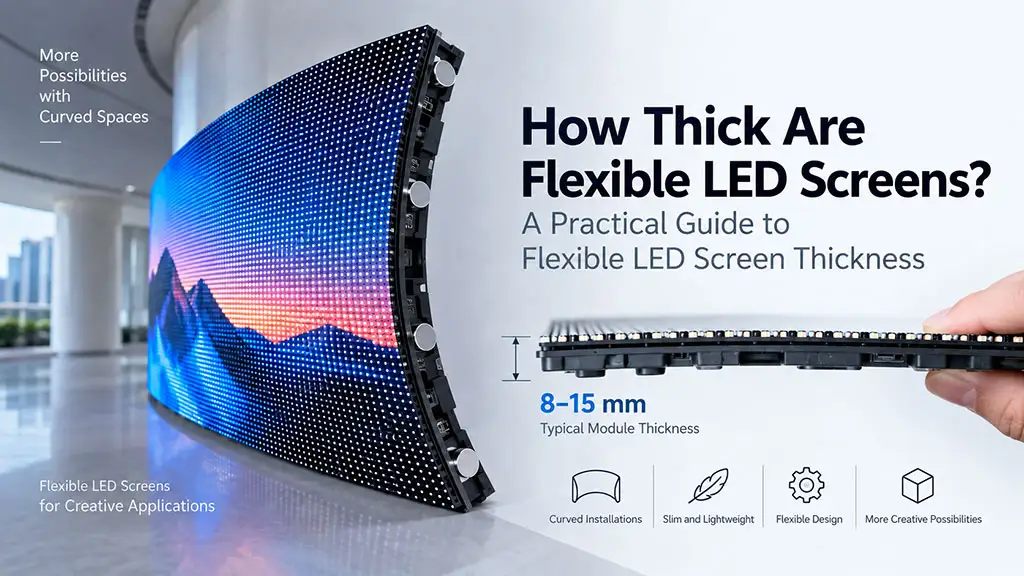
A flexible LED module is typically around 8–15 mm thick, while the total installed screen depth is usually greater once magnets, power supplies, receiving cards, cables, and the supporting structure are included.
The exact thickness varies by product design, pixel pitch, module construction, and installation method.
When an LED supplier lists the “thickness” of a flexible LED screen, the specification may refer only to the LED module rather than the depth of the complete installed display.
This guide explains the different measurements and what buyers should check when planning a slim or curved LED display installation.
What Is Flexible LED Screen Thickness?
Flexible LED screen thickness can refer to several different measurements.
The most common is module thickness: the distance from the front LED surface to the back of the flexible module. However, a finished LED display requires more than the LED module itself.
Depending on the design, the complete installation may include:
- Flexible LED modules
- Magnetic mounting components
- Power supplies
- Receiving cards
- Power and signal cables
- Steel or aluminum supporting structure
- Ventilation and maintenance space
For this reason, a module described as 10 mm thick does not mean the finished LED screen will have an installation depth of only 10 mm.
When comparing products from different manufacturers, always confirm which measurement is being quoted.
How Thick Are Flexible LED Screens?
For many commercial flexible LED displays, the LED module itself is approximately 8–15 mm thick.
However, there is no universal thickness for every flexible LED screen.
A useful way to understand the dimensions is to separate the display into different layers:
| Component | Typical Thickness / Space | Function |
|---|---|---|
| Flexible LED module | Approx. 8–15 mm | Displays the image |
| Magnetic mounting system | Varies by design | Attaches modules to the structure |
| Cables and connectors | Additional clearance required | Power and signal transmission |
| Power supply / receiving card area | Depends on layout | Powers and controls the display |
| Supporting structure | Project-specific | Creates the required screen shape |
| Complete installation depth | Project-specific | Depends on all components above |
Note: These figures are general reference ranges rather than specifications for every Highcolor product. Actual dimensions should be confirmed according to the selected pixel pitch, module design, and project structure.
This is especially important for architectural projects where the LED display must fit inside a limited installation depth.
Flexible LED Module Thickness vs. Complete Screen Depth
One of the most common mistakes when specifying a flexible LED display is confusing module thickness with total screen depth.
Flexible LED Module Thickness
The module is the flexible part of the display containing the PCB, LEDs, driver ICs, mask, connectors, and rear mounting components.
Because flexible modules do not use the same rigid cabinet structure found on many conventional LED displays, they can be relatively thin and lightweight.
This makes them suitable for:
- Cylindrical columns
- Concave walls
- Convex walls
- Curved retail displays
- Exhibition installations
- Custom-shaped LED structures
But the module is only one part of the finished display.
Total Installed Thickness
The actual installation depth must also accommodate the components behind the LED modules.
For example, a project may require room for power supplies and receiving cards behind the screen. Another project may place these components in a separate service area to reduce the depth directly behind the display.
The structural design can therefore have a greater impact on total screen thickness than the LED module itself.
For projects with strict space limitations, buyers should provide the manufacturer with the maximum allowable installation depth, rather than simply asking for the thinnest flexible LED module.
What Determines Flexible LED Screen Thickness?
Several factors affect the final thickness of a flexible LED display.
1. Flexible PCB and Module Construction
Unlike a standard rigid LED module, a flexible LED module uses a PCB and structural design that allow the module to bend.
The PCB, LEDs, driver components, protective layer, rear housing, magnets, and connectors all contribute to the final module thickness.
A thinner module is not automatically a better module. The design must still provide sufficient mechanical stability, heat management, component protection, and reliable electrical connections.
2. Pixel Pitch
Pixel pitch refers to the center-to-center distance between adjacent LED pixels.
Flexible LED screens are available in different pixel pitches for different viewing distances and applications.
Pixel pitch does not determine thickness by itself, but different pixel-pitch products may use different PCB layouts, LED packages, driver components, masks, and rear structures.
Therefore, buyers should check the actual mechanical drawing for the specific model rather than assuming that all flexible LED modules from the same product family have identical dimensions.
3. Magnetic Mounting System
Flexible LED modules are commonly installed using magnets.
The magnetic mounting system makes it easier to attach modules to a curved steel structure and allows front access for maintenance.
However, magnets and their mounting points also occupy space behind the module.
When calculating the total depth, the dimensions of the mounting system must therefore be included.
4. Power Supply and Receiving Card Placement
The LED modules require power supplies, receiving cards, HUB boards or related control components depending on the system design.
These components can be installed directly behind the LED display or positioned elsewhere within the structure.
For a very shallow installation, component placement should be considered during the structural design stage rather than after the LED modules have been selected.
5. Supporting Structure
The supporting structure often determines the final depth of a curved LED screen.
For example, installing flexible LED modules around an existing round column may require only a relatively compact steel framework.
Building a large free-standing curved LED wall may require a much deeper structure for strength and stability.
The screen’s overall dimensions, curvature, installation environment, maintenance method, and structural loads should all be considered.
Does a Thinner Flexible LED Screen Bend More Easily?
Not necessarily.
Screen thickness and flexibility are related to the mechanical design, but thickness alone does not determine how tightly an LED module can bend.
A more useful specification is the module’s minimum bending radius or the minimum diameter of the curved structure it can accommodate.
For example, two flexible LED modules may have similar thicknesses but different allowable bending radii because they use different PCB designs, rear housings, magnet layouts, and component arrangements.
If your project involves a small cylindrical column or a tight concave curve, ask the manufacturer for:
- Minimum bending radius
- Maximum recommended bending angle
- Module dimensions
- Magnet layout
- Mechanical drawing
- Recommended supporting structure
These specifications are more useful than module thickness alone when determining whether a product can achieve the required shape.
How Does Flexible LED Screen Thickness Affect Installation?
A thinner display can be useful where installation space is limited, but several other factors should be evaluated at the same time.
Limited Installation Space
Retail stores, exhibition booths, showrooms, museums, and architectural interiors sometimes have very little space available behind the LED display.
In these projects, reducing the depth of the module and supporting structure can help the LED screen integrate more naturally into the surrounding architecture.
Curved Columns
For a column installation, excessive screen depth increases the final diameter of the finished column.
A slimmer module and mounting structure can help keep the LED surface closer to the original architectural shape.
Maintenance Access
Reducing screen depth should not make maintenance unnecessarily difficult.
Many flexible LED displays use front magnetic installation, allowing technicians to remove individual modules from the front rather than requiring a large rear maintenance space.
The locations of power supplies and receiving cards must still remain accessible.
Heat Dissipation
A very thin structure leaves less internal space for heat to dissipate.
Thermal management should therefore be considered together with screen depth, particularly for high-brightness installations or displays operating for long periods.
The goal should not simply be to build the thinnest possible screen. It should be to achieve the required installation depth without compromising reliability, maintenance, or thermal performance.
Flexible LED Screen Thickness for Different Applications
Different applications have different requirements.
Curved Retail LED Walls
Retail environments often prioritize a clean appearance and minimal screen depth.
The LED structure may need to fit closely against an existing wall while still providing access for module replacement and maintenance.
Cylindrical LED Columns
For cylindrical installations, both thickness and bending radius matter.
The diameter of the existing column, module width, required curvature, and supporting frame should be evaluated together.
Exhibition and Trade Show Displays
Exhibition installations may prioritize lightweight construction and fast assembly.
In this case, total structure weight and installation method may be just as important as module thickness.
Custom-Shaped LED Displays
Wave-shaped, concave, convex, and irregular LED installations usually require a customized supporting structure.
The final thickness cannot be determined from the LED module specification alone. A mechanical drawing is normally required to calculate the actual dimensions.
How to Measure the Required Installation Depth
If your project has limited space, determine the available depth before requesting a quotation.
Start by identifying:
1. Maximum installation depth
Measure the distance available from the finished LED surface to the wall or supporting surface.
2. Required screen shape
Determine whether the display is flat, concave, convex, cylindrical, wave-shaped, or another custom shape.
3. Curvature or radius
For curved installations, provide the radius or diameter whenever possible.
4. Maintenance method
Determine whether the screen needs front maintenance, rear maintenance, or a combination of both.
5. Component location
Confirm where power supplies, receiving cards, cables, and distribution equipment can be installed.
With this information, the LED manufacturer can recommend a module and structure rather than simply quoting a module thickness.
What Should You Ask a Flexible LED Screen Manufacturer?
If thickness is important to your project, avoid asking only:
“How thick is your flexible LED screen?”
Instead, request the complete dimensional information:
- What is the LED module thickness?
- What are the module dimensions?
- What is the minimum bending radius?
- How much space do the magnets require?
- Where are the power supplies installed?
- Where are the receiving cards installed?
- What is the recommended structural depth?
- What is the estimated total installed depth?
- Is the screen front-serviceable?
- Can you provide a mechanical drawing before production?
These questions give your installation team much more useful information than a single thickness number.
For projects involving curved walls, columns, or custom shapes, providing drawings early can also help the manufacturer identify potential structural or maintenance problems before production.
Is the Thinnest Flexible LED Screen Always Better?
No.
Thickness is only one part of flexible LED screen design.
Choosing an extremely thin product without considering mechanical strength, heat dissipation, maintenance, bending performance, and component protection can create problems later.
For a commercial installation, the better objective is to find a screen that balances:
- Slim construction
- Required bending radius
- Image quality
- Structural stability
- Heat dissipation
- Front maintenance
- Installation efficiency
- Long-term reliability
The correct balance depends on the project.
자주 묻는 질문
How thick is a flexible LED screen?
The flexible LED module itself is commonly around 8–15 mm thick, although the exact specification varies by manufacturer and model. The complete installed LED screen will be thicker because it also requires mounting components, cables, power supplies, control equipment, and a supporting structure.
How thin can a flexible LED display be?
Some flexible LED modules are designed to be very slim, but buyers should compare the complete installation depth rather than module thickness alone. The thinnest module does not necessarily produce the thinnest practical installation.
Does pixel pitch affect flexible LED screen thickness?
Pixel pitch can indirectly affect module construction because different models may use different LED packages, PCB layouts, driver components, and structural designs. Always check the mechanical specifications of the exact pixel pitch being considered.
Are flexible LED screens thinner than conventional LED displays?
They can be. Flexible LED modules typically eliminate the large rigid cabinet used by many conventional LED displays. However, the final comparison depends on the mounting structure and placement of power and control components.
How much space is needed behind a flexible LED screen?
There is no single standard depth. The required space depends on the LED module, magnets, supporting structure, power supply placement, receiving cards, cables, thermal requirements, and maintenance method. The manufacturer should calculate the required depth from the project drawing.
What information should I provide for a curved LED screen project?
Provide the screen width and height, required pixel pitch or viewing distance, curve direction, radius or diameter, maximum installation depth, installation environment, and any available CAD or architectural drawings.
When asking “How thick are flexible LED screens?”, the most important distinction is between the thickness of the flexible LED module and the depth of the complete installed display.
A typical flexible LED module may be approximately 8–15 mm thick, but the final installation requires additional space for magnets, cables, power supplies, receiving cards, and the supporting structure.
For projects where depth is critical, don’t select a flexible LED screen based on the module thickness alone. Consider the total installed depth, bending radius, maintenance access, structural design, and component layout together.
Highcolor manufactures flexible LED display solutions for curved walls, columns, retail environments, exhibition spaces, and other custom installations. If you have a project with a strict thickness or curvature requirement, send us the screen dimensions, radius or diameter, installation environment, and available structural drawings. Our team can evaluate the required module and installation structure before production.
최신 제품 및 소식을 받아보세요
전 세계 파트너 여러분을 위해 마련된 신제품 출시 소식, 업계 동향, 특별 혜택을 받아보시려면 뉴스레터를 구독해 주세요. 귀사의 비즈니스에 중요한 최신 정보를 통해 한 발 앞서 나가세요!